






Fanga Part 3
Fanga: Drum, Dance and Rhythm
Robert J. Damm is a professor of music and director of music education partnerships at Mississippi State University in Starkville, Mississippi. He has studied music and dance in Cuba, Ghana, and Mali and is a certified Orff-Schulwerk teacher. He can be contacted at rdamm@colled.msstate.edu.
also:
Many drummers, especially jembe players involved in drum circles, have been introduced to a rhythm referred to as fanga. An online search for fanga generates endless musical arrangements, drum transcriptions, lyrics, translations, recordings, discussions, and speculations. Much of the material on the websites is offered without a citation of sources, which makes it very difficult to judge the validity and accuracy of the information provided. A search of primary sources reveals that fanga is a drum, a dance, and a rhythm.
FANGA IS A DRUM
Traditional music in Liberia, West Africa features many percussion instruments, among them the sasaa (gourd rattle), kleeng (slit log drum), gbengbeng (plucked lamellaphone related to the so-called “thumb piano”), sangba (djembe-like hand drum not to be confused with the djun djun in Mali, also called sangba), and the fanga (talking drum). Dr. Lester Monts, regarded as one of the world’s leading scholars on the music of the Vai people of Liberia, shared the following information:
Fanga is the Gio name for the talking drum (Figure 1) in Liberia, West Africa. Fanga refers to the double headed, hourglass shaped pressure drum common among the Gio, Loma, and Kisi peoples. Although the name of the instrument may be pronounced differently by various
ethnic groups, fanga always refers to a drum. The instrument may be played singularly, or in sets of two or three. The fanga is particularly used to accompany praise singers. Musicians from these ethnic groups were often hired by Mende and Vai chiefs as court musicians (personal communication, 2010).
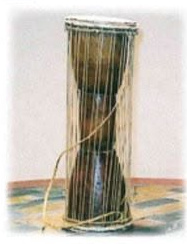
Fanga collected in Liberia by Dr. Lester Monts. Courtesy of Dr. Lester Monts.
FANGA IS A DANCE
Asadata Dafora Horton (1890–1965) was born in Freetown, Sierra Leone (Figure 2). His great-great-grandfather had returned to Africa after living as a slave in Nova Scotia where he had adopted the surname of his master. Asadata Dafora dropped his surname, moved to New York in 1929, and began teaching traditional West African dances to a group of dancers, drummers, and singers (Perpener, 105–107).
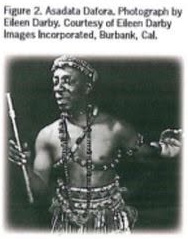
Photograph by Eileen Darby. Courtesy of Eileen Darby Images Incorporated, Burbank, Cal.
In 1934, Dafora staged Kykunkor, a dance program based on the folklore of the Mende ethnic group of Sierra Leone (Perpener, 108). The show attracted enthusiastic audiences who had never seen authentic African dancers (Perpener, 112). The four drummers playing for Dafora at this time were Udo Enooff, Abiodun Salako, and Ezebro Ejioho from Nigeria and Sakor Jar from Liberia (Creque-Harris, 77). Babatunde Olatunji was in Dafora’s company for the 1958 revival of Zunguru, which included a performance in “Salute to Kwame Nkrumah, Prime Minister of Ghana” (Heard, 238). Dafora laid the foundation for professional African drum and dance troupes in the United States. He is credited with being the first to successfully stage African ritual in a Western style production (Charry in Olatunji, 2005, 9).
In 1938, Asadata Dafora and his Shogola Oloba dance company in New York performed an African dance-drama called Zunguru, which featured a dance of welcome called Fanga (Creque-Harris, 81–82). Dafora brought the Fanga dance with him from West Africa (Heard, 86). Dafora sometimes called this same dance Fugala or The Dance of Welcome (Heard, 191). In 1943, Dafora and his company were featured at the African Dance Festival at Carnegie Hall. It was in this program that a young guest artist named Pearl Primus performed a dance she called African Ceremonial (Perpener, 124), which may have been Fanga, the Dance of Welcome, as choreographed and taught by Dafora (Heard, 190).
Pearl Primus (1919–1994), dancer, choreographer, and anthropologist, popularized the Fanga dance in the United States. She extracted the essence of the original dance and shaped it into a relatively short solo presentation containing a wealth of hospitable gestures. She first presented her Fanga dance at a performance at the Executive Mansion in Monrovia, Liberia in 1949. The dance was set to traditional Gio fanga ensemble music performed by indigenous singers and percussionists (McDonagh, 239–240). In other words, Primus adapted a greeting dance in Liberia that was accompanied by fanga drums. She subsequently named her dance Fanga. Similarly, one of the African festival dances choreographed by Dafora was called Asbiko, also the name of an African drum (Heard, 325).
The use of the same word to refer to an instrument, a dance, and a song is a common occurrence in West Africa (L. Monts, personal communication, 2010). Another example is kpanlogo—a drum, rhythm, dance, and music form that originated from the Ga people of Ghana.
Primus toured internationally and performed expanded programs of her African works throughout the 1950s. In 1953, she journeyed to Trinidad, the place of her birth, where she met Percival Borde, a lead dancer whom she married in 1954. Primus’s dance company, which included sisters Joan and Merle Derby, performed dances that she and Borde choreographed (Creque-Harris, 148–149). In an interview for the Free to Dance video (Lacy, Zucker, and Underwood, 2001; unpublished video footage held in American Dance Festival Archives), Merle Derby said:
Fanga was a dance of welcome…. When Pearl introduced the fanga, we studied and listened to the rhythms very closely because the music and the dance were closely integrated; they were one.
In 1961, Primus returned to the United States and continued her choreography of African dances. She and Borde directed a production called African Carnival, a pageant featuring African village settings. The storyline involved an African sailor who had marveled at the similarities in dance styles that he witnessed in his travels from the Caribbean to Africa. He invited guests from the Caribbean to tour Africa to see a presentation of the dances from various tribes and villages. The two-hour program consisted of a variety of African dances set to the accompaniment of drums (Creque-Harris, 153). Babatunde Olatunji was a featured soloist in the show. Other drummers included in the program were Chief Bey, Taiwo Duval, and Mongo Santamaria (Primus, Long, and Borde). There must have been a tremendous interaction and synergy among the dancers and drummers in New York who were staging African dance and music. Dafora, Primus, Joan and Merle Derby, Olatunji, Chief Bey, and Duval worked together in various configurations through the years.

FANGA IS A RHYTHM
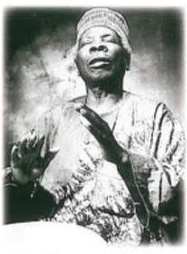
Babatunde Olatunji entered the United States in 1950 on a scholarship to Morehouse College in Atlanta. Upon graduation, he moved to New York City where he began to perform with Dafora. He later formed his own company and in 1959 made the classic Drums of Passion recording (Heard and Mussa in DeFrantz, 148). It was also in 1959 that Olatunji and his company appeared at the International Folk Song and Dance Festival where they performed several dances, including Fanga. Chief Bey and Taiwo Duval drummed with Olatunji for that program (Derby, 10–11). Olatunji’s repertoire of songs and dances included Gbeonde, which he borrowed from Dafora by way of Dafora’s dancers, and Fanga, which was contributed by the Derby sisters who had learned it from Primus (Derby, 10). Olatunji built on the material and expertise that were contributed by these and other dancers who joined his performing troupe after they had previously worked with Dafora or Primus (Charry in Olatunji, 2005, 10).
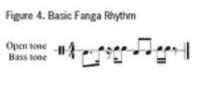
The fanga rhythm seems to generally refer to a specific lead drum (e.g., jembe) pattern (Figure 4) as played by Olatunji, Chief Bey, et al. Olatunji used the Gun-Dun, Go-Do, Pa-Ta method of teaching drum tones and patterns through speech, which he explained was derived from the Yoruba language (Olatunji and LeBow, foreword). Olatunji did not always designate right and left hands (e.g., Gun-Dun) in the written notations but it is presented here (Figure 5) to promote a fluid hand-to-hand movement. Olatunji included a conga pattern, the lead drum pattern, and four additional variations in the Drums of Passion Songbook as rhythms to be played with the Fanga song (Olatunji and LeBow, 28). The variation included in Figure 5 is often played as a second, or supporting, drum pattern as seen in published transcriptions. Olatunji’s percussion ensemble also added a shekere part when they accompanied Merle Derby on the Fanga dance recorded for the Free to Dance video (Lacy, Zucker, and Underwood, 2001; unpublished video footage held in American Dance Festival Archives).
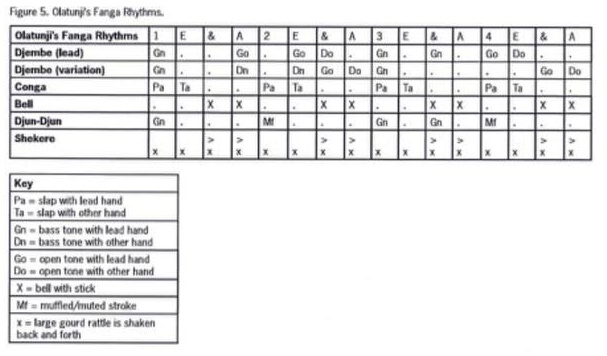
Olatunji played variations on the standard lead drum rhythm in his African Drumming instructional video in the section called “Trio Performance Using the Preceding Patterns.” In this case, an accompaniment was provided on the added bell and djun-djun (Olatunji, 1993). Thus, the transcription referred to as Olatunji’s Fanga Rhythms (Figure 5) includes patterns for bell, rattle, and drums compiled from three different sources.
Chief James Hawthorn Bey (Figure 6), a specialist in African drumming, worked closely with Pearl Primus. In addition to his work with Primus and Olatunji, he is remembered for his 1960s recordings with Herbie Mann, Art
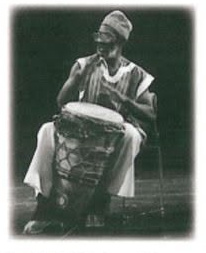
Photograph by Mansa K. Mussa. Courtesy of Mansa K. Mussa.
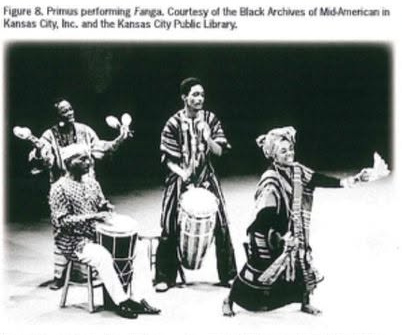
Courtesy of the Black Archives of Mid-America in Kansas City, Inc. and the Kansas City Public Library.
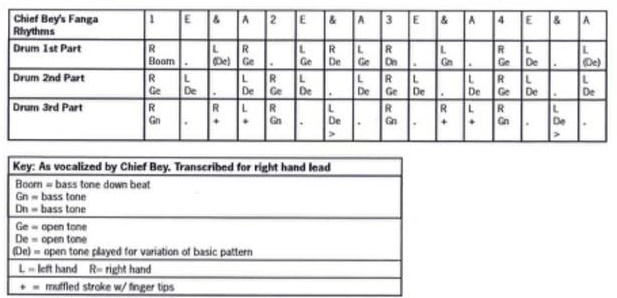
Blakey, Pharoah Sanders, Harry Belafonte, and Miriam Makeba. Chief Bey demonstrated “the three parts of Fanga” (Figure 7), explaining that “the bottom part is a rumba” (Lacy, Zucker, and Underwood, 2001; unpublished video footage held in American Dance Festival Archives).
Notice that the “Fanga rhythm” in these transcriptions is being played on the jembe, conga, and djun-djun, but not on the talking drum (i.e., fanga). “The drummer most often associated with Primus was Alphonse Cimber, a Haitian, who worked his superior abilities into Primus’s creations from the early 1940s until his death in 1981. His contributions were mostly Caribbean rhythms; African rhythms were usually provided by Norman Coker of Gambia and Moses Mianu of Nigeria” (Murray, 256). Cimber and Coker were longstanding members of Dafora’s Shogola Oloba before they became drummers for Primus (Heard, 184). Looking at the 1970s photograph of Primus performing Fanga (Figure 8), one can observe that she was accompanied on conga (by her son Onwin Borde), on ashiko drum (by an unidentified drummer who appears to be Chief Bey), and with maracas (perhaps played by Helen Tinsley). Apparently, she did not have an ensemble of indigenous Gio fanga musicians
© 2026 rcanzlovar.com | About | Contact | Privacy Policy |