






Fanga Part 2
Fanga Alafia History and Meaning
Robert J. Damm is a professor of music and director of music education partnerships at Mississippi State University in Starkville, Mississippi. He has studied music and dance in Cuba, Ghana, and Mali and is a certified Orff-Schulwerk teacher. He can be contacted at rdamm@colled.msstate.edu.
also:
The issue of authenticity is an important consideration among contemporary music educators committed to a multicultural curriculum. Concerns about authenticity may lead music educators to question aspects of repertoire such as the historical, geographical, and cultural background of a song, any associated dance and accompaniment, the correct translation of a song, and whether a “version” of a song and dance are representative of their original forms. A case in point is the ubiquitous Fanga Alafia song, said to be from Africa. An online search for “Fanga” or “Fanga Alafia” generates endless musical arrangements, drum transcriptions, lyrics, translations, recordings, discussions, and speculations, but no two sites provide the same information. Most of the material posted on various Web sites is offered without citation of sources, which makes it difficult to judge the validity and accuracy of the information provided. Actually, Fanga/Fanga Alafia represents the creative spirit of nearly a century of dancers, drummers, and music teachers who, although living in the United States, were inspired by various stylistic elements, themes, and practices thought of as African and whose interpretations were done in tribute to African cultures.
THE MELODY
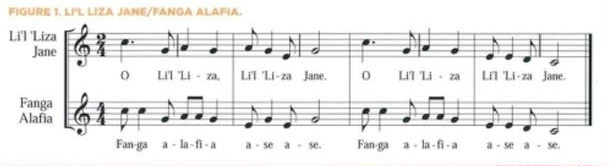
Various forms of the Fanga Alafia song and dance have been taught at music education conferences throughout the United States since the 1980s. The melody owes its origins to the Negro folk song “Li’l Liza Jane.”¹ The pentatonic melody of Fanga Alafia is nearly identical to the refrain of “Li’l Liza Jane” (fig. 1). “Li’l Liza Jane,” also known as “Little Liza Jane” and “Liza Jane” dates back to at least the 1910s. The song’s origins, however, seem to go back even earlier. The name “Liza Jane” or “Eliza Jane” was a standard female character name in minstrel shows. “Li’l Liza Jane” was first published in 1916 by Sherman, Clay & Co. of San Francisco, its composition attributed to Countess Ada de Lachau. It was described as a “Southern dialect song.” The tune was featured in the 1916-1917 show “Come Out of the Kitchen.” Earl Fuller’s Famous Jazz Band recorded “Li’l Liza Jane” in 1917 on the Victor label. One may listen to a digitized version of the original 78 rpm disc by going online to the Internet archive.² Natalie Curtis-Burlin’s book Negro Folk-Songs, published in 1918, documents a version said to be an African American folk song with an associated dancing game. In the “Liza Jane” dance, couples would dance in a circle, with an extra man in the middle.
The extra man would “steal partners” from one of the couples, and the odd man out would go into the center and improvise a solo dance, then cut in on another couple and the process would repeat.³ Harry T. Burleigh, in “The Negro and His Song,” wrote that of all the African American folk songs, “none is so gay as ‘Li’l Liza Jane’, of the Mississippi levees.” “Li’l Liza Jane” became a standard both as a song and an instrumental tune in traditional jazz, New Orleans brass band, folk, and bluegrass music.
THE LYRICS
Despite clear evidence regarding the melodic origin of Fanga Alafia, the origin of the lyrics remains unclear. There are two claims to authorship: that of LaRocque (pronounced la-ROCK) Bey and that of Babatunde Olatunji. LaRocque Bey established the LaRocque Bey School of Dance in Harlem, New York, in 1960. While teaching a children’s African dance class, Bey added Yoruba words to the “old time” plantation day’s melody to make a vocal accompaniment for the Fanga dance.⁴ This account was given by Taiwo Duval when he was interviewed by Sule Greg Wilson. However, Babatunde Olatunji, the Nigerian-born drummer well-known for popularizing African drumming in the United States,
© 2026 rcanzlovar.com | About | Contact | Privacy Policy |